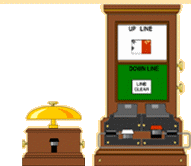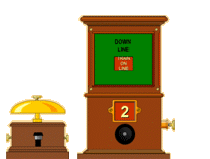





About our Portcreek Junction Simulation.
This simulation has been developed specifically for beginners who have perhaps already got to grips with the basics and are now ready for the next step. As well as the usuals of passing trains, the challenges of routing them and juggling conflicts through the junction are added, without the stresses of running a larger box represented by our Advanced series of SimulationsAbout The Prototype
The box which is the
prototype for this Simulation was located on the former LBSCR and LSWR
Portsmouth Joint Line. It supervised the Junction between the
Joint
Line route between Portsmouth and Cosham and the LBSCR line to
Havant (where the LSWR route to Guildford and Waterloo diverged) and
onwards to Brighton. Thus is can be seen that the ultimare destinations
and routings of trains can be many and varied!The box closed in 1968 after around a hundred years of faithful service - its functions being taken over by the then newly-opened Portsmouth Panel Signal box - which was itself superceded, after a traumatic start, by the Havant Signalling Centre in 2007
This stretch of railway has always been busy, with a steady stream of trains heading into and out of Portsmouth to a range of destinations around the South and West of England, with traffic for Salisbury, Southampton and the West taking the divergent route at Portcreek Junction, whilst trains for London Waterloo, London Victoria and Brighton etc continue along the Mainline to diverge at Havant. Of course, as elesewhere on the South Coast, summer Saturdays with the added holiday traffic - including non-stop Waterloo - Portsmouth services, and countless special trains for all over the country - were something special. Indeed, with over 25 trains per hour at the peak, it is quite likely that Portcreek was one of the busiest double junctions on the whole of the Southern Region. Needless to say, we have included just such a timetable with the simulation...

Traffic and Operations
The main line at Portcreek was
electrified on the Southern Railway's 660V DC Third Rail system in 1937
and much of the traffic therefore consists of multiple unit
passenger trains. The line to Fareham and Eastleigh and the West
however, remained the province of loco haulage until after Portcreek
Junction box closed. Correct routing and describing of trains
without causing delay or causing mayhem at Fratton or Portsmouth is
therefore key to success!The timetables for the simulation are set in the mid 1950's and early 60's and therefore the loco-hauled trains are mainly in the hands of steam locomotives - often of rather ancient vintage. It would be unwise to bring a 6-coach local to a stand at the Home Signal on the sharply curved Down Branch if it is hauled by a T9 4-4-0 which might struggle to get its train underway promptly. Luckily, in the simulation, we do not replicate the torrent of abuse from the crew which might have resulted in the real world of the 1950's!!
Degree of difficulty – 4 out of 10